
Did you know that nearly half of the honey imported into Europe is suspected of being stretched with cheap sugar syrups? It's a disheartening reality for anyone who values the purity of what they eat; it makes finding authentic raw wildflower honey UK wide feel like a daunting task amongst the rows of identical, processed supermarket jars. You likely feel that a product labelled as "pure" should be exactly that, yet the gap between industrial blending and the quiet, sun-drenched reality of a British meadow grows wider every year.
This guide will help you reclaim a genuine connection to the land by showing you how to identify truly artisanal nectar. You'll discover the vibrant health benefits of untreated honey, learn to decode confusing labels, and find out how to support the independent beekeepers who act as humble stewards for our precious bee populations. From the first bloom of a spring orchard to the deep amber hues of late summer, we'll help you navigate the journey from hive to home so you can enjoy the unadulterated taste of the British countryside with total confidence.
Key Takeaways
- Understand the vital distinction between processed supermarket blends and unpasteurised, coarse-filtered nectar that retains its natural health properties.
- Discover how the shifting palette of the British seasons creates a unique, complex flavour profile within every harvest of raw wildflower honey UK.
- Learn to navigate confusing labelling regulations and avoid adulterated imports by connecting directly with independent, small-scale beekeepers.
- Explore the nutritional richness of wildflower honey, including the enzymes and antioxidants that support your well-being.
- Recognise the ecological importance of choosing local honey, which helps preserve the biodiversity of our meadows and the heritage of traditional beekeeping.
Understanding Raw Wildflower Honey in the UK
Picture a British summer meadow in late July. The air hangs heavy with the scent of sun-warmed grass and the steady, rhythmic hum of thousands of wings. This vibrant, buzzing landscape is the true origin of raw wildflower honey UK, a substance that is far less a commercial product and much more a liquid record of a specific time and place. Unlike the uniform, clear jars found on supermarket shelves, this honey isn't manufactured to a predictable recipe. It is gathered, droplet by precious droplet, from a shifting tapestry of local flora. It's a living food, captured in a jar, reflecting the very soul of the British countryside.
What Does 'Raw' Actually Mean in the UK?
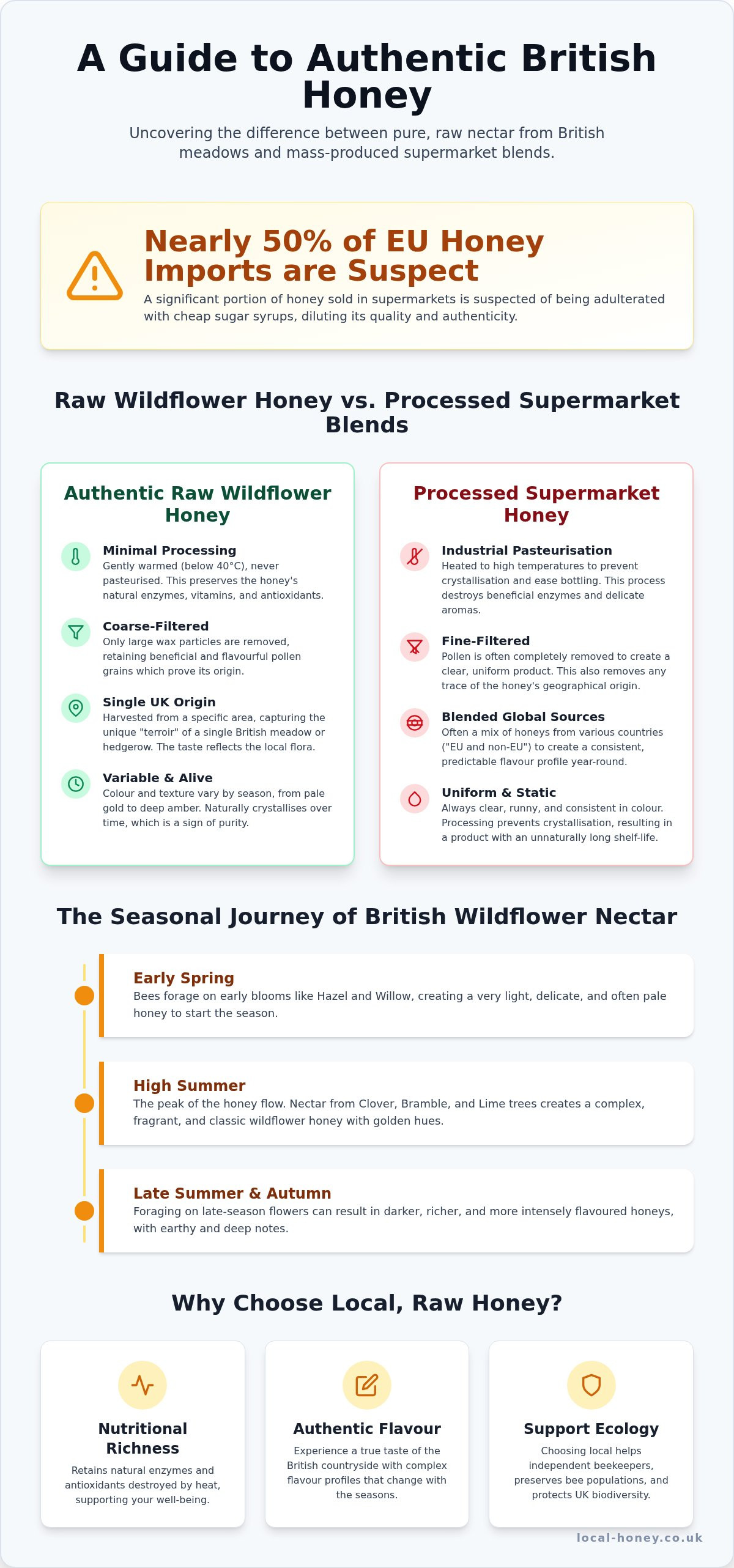
In the context of British beekeeping, "raw" is a quiet promise of minimal interference. It means the honey has never been subjected to high-heat pasteurisation. Industrial producers often use extreme heat to prevent crystallisation and speed up the bottling process, but this strips the honey of its vitality. Authentic raw nectar is kept below 40°C, which is roughly the natural temperature found inside a working hive. This gentleness preserves the delicate enzymes, antioxidants, and complex aromas that heat would otherwise destroy. We also rely on coarse-filtering. This simple, tactile process removes large bits of wax or debris whilst leaving the microscopic grains of beneficial pollen completely intact. Commercial "fine-filtered" honey often strips these away, removing the very markers that prove the honey's unique geographical heritage.
The Wildflower Distinction: A Multi-Floral Symphony
Wildflower honey is inherently poly-floral. This means it is created from the nectar of a vast and beautiful array of honey plants that thrive across our varied landscape. Depending on where the hives are placed, the bees might spend their long summer days amongst the white clover of a quiet pasture, the tangled brambles of a wild hedgerow, or the fragrant hawthorn and lime trees of a country lane. This diversity creates a unique "terroir". Much like a fine wine, the character of the honey is dictated by the soil, the rainfall, and the specific mix of blossoms available to the colony. It's the most honest representation of a landscape you can taste. One harvest might be pale and citrusy, whilst the next is deep, amber, and earthy. It's a natural symphony that changes with every season.
The Seasonal Journey of British Wildflower Nectar
The production of raw wildflower honey UK begins long before the first jar is ever opened. It starts with the delicate blossoming of hazel and willow in early spring, a quiet signal to the colony that the season of plenty has returned. From this moment until the final frost-nipped flowers of autumn fade, the bees engage in a tireless, rhythmic dance with the landscape. This isn't a factory process. It's a seasonal narrative written by the weather, the soil, and the wind. Every drop is a tiny piece of a larger ecological puzzle, reflecting the health and vitality of the British countryside.
From Meadow to Hive: The Foraging Process
A single honeybee can travel up to three miles from its hive to find the best nectar sources. Imagine the sheer scale of that journey; it's a monumental feat of navigation and endurance for such a small creature. Once the nectar is gathered, the transformation begins immediately. Inside the hive, bees add specific enzymes that break down complex sugars, whilst simultaneously fanning their wings to create a constant airflow. This natural dehydration process is vital. It reduces the moisture content until the nectar thickens into the viscous, shelf-stable gold we recognise. This transformation is governed by UK honey regulations, which ensure that nothing is added or taken away from this natural substance. It remains pure, raw, and untouched.
The beekeeper acts as a humble steward throughout this cycle. They don't dictate the flavour or the texture. Instead, they observe the soil chemistry and the rainfall, knowing that a wet spring might favour the clover whilst a heatwave could make the lime trees yield a more intense, minty nectar. It's a partnership of patience and respect for the natural world.
Why No Two Jars Are Ever the Same
Every harvest is a limited edition. Because the bees forage on whatever is blooming in their immediate vicinity, the resulting honey is a unique fingerprint of that specific meadow. You might find one batch is a pale, shimmering amber with the light scent of spring blossoms. Another, harvested just a few miles away or a month later, could be a deep, dark gold with the earthy undertones of late summer brambles. These variations aren't flaws. They are the hallmarks of authenticity. We celebrate these "imperfections" because they prove the honey hasn't been blended into a characterless, industrial average. Every jar tells a story of a specific field, a specific week, and a specific colony. If you're looking to experience these shifts in flavour for yourself, you can find a local beekeeper who bottles the seasons as they happen. It's a tactile connection to the rhythms of the British year that no supermarket blend can ever replicate.
Raw Wildflower Honey vs Supermarket Blends
Walk down any major supermarket aisle and you'll find rows of identical, crystal-clear squeeze bottles. They're often priced enticingly low, yet a quick glance at the back of the jar reveals a vague, unsettling phrase: "Blends of EU and non-EU honeys." This isn't a description of a single origin, but rather a sign of a global industrial machine. It's a mixture of harvests from different continents, blended in massive vats to achieve a uniform colour and taste that never varies. When you choose raw wildflower honey UK, you're stepping away from this characterless production and embracing a product with a vibrant, local soul.
The difference in carbon footprint is staggering. Whilst a supermarket blend might travel thousands of miles across oceans before reaching your toast, local honey often moves just a few miles from the hive to the farm gate. This proximity ensures a level of freshness and traceability that large-scale operations simply can't match. You aren't just buying a sweetener; you're supporting the specific ecosystem that surrounds you. Of course, this artisanal approach carries a different price tag. A 340g jar of authentic British honey typically ranges from £7 to £15, reflecting the true cost of small-scale stewardship and the unpredictable nature of our British weather. It's an investment in quality and the survival of our local bee populations.
The Hidden Truth of 'Pure' Honey Labels
The term "pure" on a label is often a legal minimum rather than a badge of quality. To keep those squeeze bottles flowing, industrial producers use high-heat pasteurisation that destroys the delicate aromas and vital enzymes we value. This process also prevents the honey from crystallising, giving it a sort of artificial "immortality" on the shelf. More concerning is the risk of adulteration. A 2021-2022 EU report titled "From the Hives" found that 46% of tested honey samples were suspected of being stretched with cheap sugar syrups. In such a vast, opaque supply chain, the connection to the original blossom is completely lost.
Why Small-Batch Production Preserves Quality
Independent beekeepers work at a much slower, more reverent pace. They utilise "cold-clearing" methods, allowing the honey to settle naturally rather than forcing it through fine filters. This patience preserves the microscopic grains of pollen that provide a map of the local landscape. According to the British Beekeepers Association on honey, the composition of these natural sugars and minerals is what gives wildflower nectar its unique character. By choosing small-batch harvests, you're fostering a direct connection with a producer who knows exactly which meadow their bees foraged in last Tuesday. It's a relationship built on transparency and a shared love for the natural world.
Wildflower Honey Health Benefits and Uses
Beyond its complex floral notes, raw wildflower honey UK serves as a potent, functional food that has been cherished for generations. When nectar remains in its unadulterated state, it acts as a complex reservoir of living elements that industrial processing simply cannot replicate; it's a gentle, nurturing addition to the pantry, offering more than just sweetness. Every spoonful carries the quiet strength of the British meadows, providing a natural boost that works in harmony with your body. It's a testament to the fact that the most effective remedies are often those found closest to home.
The Nutritional Profile of Unpasteurised Nectar
The true power of raw honey lies in its delicate enzymes, such as amylase and glucose oxidase. These active components are highly sensitive to heat, which is why the "raw" status is so vital. Amylase helps break down starches, whilst glucose oxidase contributes to honey's well-known antibacterial properties. You'll also find a rich spectrum of trace minerals, including potassium and magnesium, which are drawn directly from the soil by the honey plants. Unlike refined sugars, raw nectar acts as a natural prebiotic, providing essential nourishment for the beneficial bacteria in your gut. It's a holistic food that supports your well-being from the inside out.
Many people turn to their local harvest during the hayfever season. The theory suggests that by consuming small amounts of local pollen found in raw wildflower honey UK, the body may become desensitised to seasonal allergens. Whilst scientific debate continues, the anecdotal evidence from generations of country folk remains strong. It's also a time-honoured remedy for soothing a ragged throat or a persistent cough, coating the senses in a warm, protective layer of floral goodness.
7 Ways to Verify Your Honey is Truly Raw
Finding authentic honey requires a bit of detective work. To help you move beyond the confusion of supermarket labelling, use this simple verification checklist:
- Look for "Raw" or "Unpasteurised": Don't settle for the word "Pure". These specific terms indicate the honey hasn't been heated above hive temperatures.
- Embrace Crystallisation: If your honey turns solid or "set," it's a sign of quality. Heat-treated honey stays liquid forever; raw honey lives and changes.
- Check for Cloudiness: Hold the jar to the light. Truly raw honey should look slightly opaque, containing microscopic grains of pollen and propolis.
- Spot the Particles: Tiny specks or a fine layer of white foam at the top are natural indicators of a raw, coarse-filtered product.
- Verify the Provenance: Can you name the specific UK apiary or county it came from? Traceability is the enemy of fraud.
- Texture and Scent: Raw honey should have a complex, floral aroma. If it just smells like sugar, it likely is.
- The Price Point: Artisanal honey costs more because it's harder to produce. If it's suspiciously cheap, it's probably not raw.
To ensure you're getting the genuine article, the safest path is to buy wildflower honey directly from UK beekeepers. This direct connection removes the veil of industrial processing and puts you in touch with the people who actually tend the hives.
Sourcing Authentic British Honey from Independent Beekeepers
Stepping away from the sterile supermarket shelf and towards the farm gate is a small act of rebellion that yields the sweetest rewards. Choosing raw wildflower honey UK isn't just about securing a better flavour; it's about joining a community of people who care deeply for the land. When you buy from an independent producer, you're often looking into the eyes of the person who tended the hives through winter frosts and summer swarms. This direct connection ensures that the honey you enjoy is as honest and vibrant as the meadow it came from. It's a shift from being a mere consumer to becoming a participant in a much older, more respectful way of living.
The Importance of Traceability and Stewardship
There is a profound sense of stewardship involved in small-scale beekeeping. Every jar is a testament to artisanal pride, often hand-labelled and personally delivered by someone who knows every hedgerow in their local parish. By supporting these local keepers, you're directly funding the survival of British honeybees. These insects provide essential pollination services for our local wildflowers and crops, maintaining the biodiversity that makes our countryside so special. It's a circular economy of care. You support the beekeeper, the beekeeper supports the bees, and the bees support the landscape we all love. This transparency removes the doubt created by global supply chains, replacing it with a quiet confidence in the purity of your food. The artisans we feature are the guardians of a traditional craft, managing their colonies with a level of patience that industrial operations simply can't afford.
How to Use the Local Honey Directory
Finding these hidden gems shouldn't be a struggle or a chore. Our directory acts as a bridge, connecting you with passionate producers who might not have a traditional shopfront but possess a wealth of expertise and heritage. Whether you're searching for the delicate, fleeting notes of blossom honey, the robust, moorland intensity of heather honey, or a classic jar of wildflower nectar, our platform makes the search simple and rewarding. We provide digital shopfronts for these small-scale artisans, allowing them to focus on their craft whilst you discover the incredible, shifting diversity of the British harvest. Every county has its own unique flavour profile waiting to be discovered. Discover your next favourite jar of raw wildflower honey today and taste the difference that true local provenance makes. The meadows are waiting, captured in every golden drop.
Bring the Spirit of the Meadow into Your Home
Choosing a jar of authentic honey is a simple yet profound way to reconnect with the rhythms of our landscape. You now understand that the "pure" label on a supermarket shelf often masks a global industrial process that strips away the very enzymes and pollen that make nectar a living food. By seeking out raw wildflower honey UK producers, you ensure that every spoonful remains unadulterated; it's a direct link to the specific blossoms and sun-drenched days of a local apiary.
Our national directory supports hundreds of independent British beekeepers, providing verified digital shopfronts where you can find traceable, artisanal harvests. This isn't just about flavour; it's about preserving the traditional crafts that keep our countryside vibrant and thriving. Find an independent UK beekeeper and buy raw wildflower honey today to experience the honest, shifting character of the seasons. Your support helps protect our precious pollinators whilst bringing a genuine piece of the British meadow to your table.
Frequently Asked Questions
Is raw wildflower honey better for you than regular honey?
Raw honey is physically superior to processed supermarket varieties because it hasn't been subjected to high-heat pasteurisation. This gentle handling ensures that delicate enzymes, antioxidants, and minerals remain intact within the jar. Regular honey is often blended and heated to stay liquid, which strips away the natural vitality that makes authentic raw wildflower honey UK a functional, living food rather than just a simple sweetener.
Why has my raw wildflower honey turned solid or cloudy?
Turning solid or cloudy is a natural process called crystallisation and is a hallmark of truly raw, unheated honey. It happens when the natural sugars in the nectar bind to microscopic grains of pollen. If your honey remains perfectly clear for months, it's likely been fine-filtered and heat-treated. To return it to a liquid state, simply place the jar in a bowl of warm water below 40°C.
Can raw wildflower honey help with my hayfever symptoms?
Many people find relief from hayfever by consuming local honey, as it contains trace amounts of the very pollen that causes seasonal allergies. The theory suggests that regular, small exposures can help desensitise your immune system to the flora in your specific area. Whilst scientific evidence is still being gathered, generations of British country folk rely on this time-honoured practice to manage their symptoms naturally throughout the summer months.
What is the difference between wildflower and blossom honey?
The primary difference lies in the specific nectar sources the bees visit during their foraging flights. Wildflower honey is polyfloral, meaning the bees have gathered nectar from a vast tapestry of meadow flowers, hedgerows, and weeds. Blossom honey often refers to nectar collected from specific flowering trees or crops, such as apple or cherry blossoms. Both are beautiful expressions of the season, but wildflower honey offers a more complex, multi-layered flavour profile.
How should I store raw honey to keep it fresh?
You should store your honey in a cool, dry place away from direct sunlight, such as a kitchen cupboard or larder. It's vital to keep the lid tightly sealed to prevent the honey from absorbing moisture from the air, which can lead to fermentation. Raw honey doesn't actually go off if stored correctly. It can last for years, though its flavour and texture will naturally evolve as time passes.
Is all UK honey raw by default?
Not all honey produced in the UK is raw, as some larger-scale producers still utilise heat-treatment and fine-filtration to meet retail demands. To ensure you are buying raw wildflower honey UK, you should look for specific labelling or buy directly from independent beekeepers. Truly raw honey is coarse-filtered and kept at hive temperatures, preserving the microscopic pollen that proves its British origin and provides its unique health benefits.
Why is raw wildflower honey more expensive than supermarket honey?
Artisanal honey is more expensive because it reflects the true cost of small-scale stewardship and the unpredictable nature of British weather. Independent beekeepers cannot rely on the massive, global blending vats used by supermarkets to keep prices artificially low. When you pay a premium for a jar, you are funding the survival of local bee populations and the preservation of traditional, labour-intensive extraction methods that prioritise quality over volume.
Can children eat raw wildflower honey?
Children over the age of one can safely enjoy raw honey, but it must never be given to infants under 12 months old. This is due to the risk of infant botulism, a rare but serious illness caused by spores that can occasionally be found in honey. For older children and adults, raw honey is a wholesome, natural treat that provides a far more nutritious alternative to refined sugars and processed syrups.


