
Discover the artisanal craft, seasonal flavours, and heritage behind the UK’s finest pure blossom honey.
In the quiet hum of a British summer, a remarkable story unfolds. It’s a story written in nectar, carried on the wings of countless bees, and captured in a jar of pure blossom honey. This is not the uniform, often characterless honey of the supermarket squeezy bottle, but a liquid snapshot of the UK’s meadows, hedgerows, and orchards at the peak of their bloom. For the conscious consumer, a jar of authentic British blossom honey is more than a sweetener; it is a connection to the land, a taste of a specific season, and a vote for a more transparent and sustainable way of producing food.
But what truly makes blossom honey “pure,” and why does its flavour profile differ so profoundly from mass-market alternatives? This journey will take you from the delicate flowers of the British countryside to the dedicated apiaries where beekeepers practise their time-honoured craft. We will explore the botanical origins of its taste, learn how to distinguish true quality from industrial blends, and discover how you can directly support the stewards of this precious tradition.
What is Pure Blossom Honey? Defining the British Summer Harvest
At its heart, pure blossom honey is the liquid gold of the British summer, a polyfloral marvel created when honeybees (Apis mellifera) forage on a wide variety of flowering plants. Unlike monofloral honeys, such as Heather or Borage, which are defined by a single dominant nectar source, blossom honey is a complex and harmonious blend, curated by the bees themselves from the diverse tapestry of flora available to them.
The term “pure” is a crucial distinction. It signifies that the honey in the jar is exactly as the bees produced it, with nothing added and nothing of value taken away. True pure honey contains no added syrups, sugars, or artificial flavourings. It is a direct transfer from the honeycomb to the jar, undergoing only minimal straining to remove wax particles, whilst preserving the precious pollen and enzymes that define its character and nutritional value. This commitment to purity is the hallmark of the independent beekeepers you'll find through Local Honey, who see themselves as custodians of nature's work.
This exquisite harvest is intrinsically linked to the seasons. The window for blossom honey typically opens in late spring and closes as summer wanes, capturing the ephemeral sweetness of a landscape in full bloom. Each jar tells the unique story of its time and place, a delicious record of a fleeting moment in the British countryside.
The Polyfloral Nature of British Nectar
A single honeybee colony forages across a radius of up to three miles, visiting millions of flowers to produce just one jar of honey. This tireless work results in a honey that is a true reflection of its local environment, or terroir. The bees will gather nectar from hedgerow hawthorn, meadow clover, garden blossoms, and towering lime trees, creating a blend that is impossible to replicate artificially.
This is why no two jars of pure blossom honey are ever exactly the same. The flavour, colour, and aroma can vary subtly from one apiary to the next, and even from one year to the next. The specific combination of nectar is dictated by the British climate—the amount of sunshine and rain determining which plants flourish and when. This beautiful variability is something to be celebrated, a delicious reminder of honey’s natural, living origins.
Why "Pure" Matters for Your Pantry
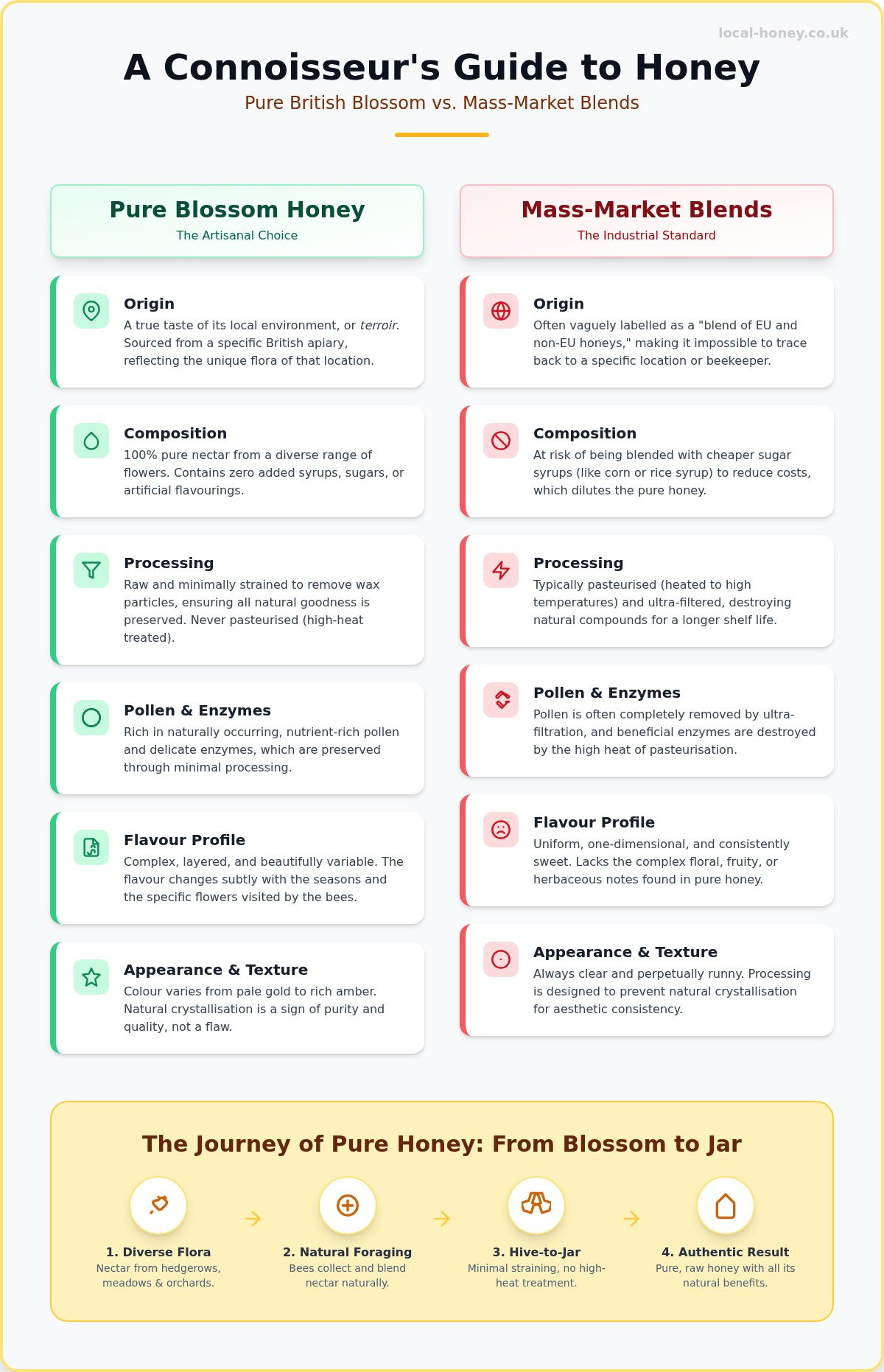
The distinction between pure, raw honey and the blended alternatives found on supermarket shelves is not merely about taste; it’s about nutritional integrity. Many mass-produced honeys are labelled "a blend of EU and non-EU honeys," a vague description for a product that has often been pasteurised at high temperatures. This heat treatment destroys the naturally occurring enzymes and delicate volatile compounds that give raw honey its complex flavour and potential health benefits. Furthermore, many are ultra-filtered, a process that removes the nutrient-rich pollen, often to slow down natural crystallisation and create a perpetually runny product.
In contrast, minimal processing preserves these vital elements. The beekeepers who champion this approach understand that their role is to interfere as little as possible. They let nature lead. In its simplest definition, pure honey is nectar that has undergone zero chemical alteration or high-heat treatment from hive to home. This commitment to authenticity is why discerning food lovers are increasingly seeking out traceable honey, building a connection with the artisans who honour this natural process.
From Hedgerow to Hive: The Botanical Origins of UK Blossom Honey
To truly appreciate a jar of pure blossom honey, one must follow the journey of the bee. Imagine a warm morning in late spring. A forager bee leaves the hive, her flight a meandering dance through the British countryside. She might visit the creamy-white flowers of a Hawthorn hedge, then move to the delicate pink-tinged blossoms of an apple orchard, before finding a sun-drenched field of white clover. Each nectar source she visits contributes a unique note to the final symphony of flavour.
This incredible biodiversity is the secret to blossom honey's complexity. A landscape rich in different plant species provides the bees with a varied diet, resulting in honey that is not just sweet, but layered with floral, fruity, and sometimes even herbaceous notes. The beekeeper’s role in this process is one of a silent partner. They are stewards of the landscape, ensuring their bees have access to healthy, diverse forage. They understand nature’s rhythm, placing their hives in locations where the bees can thrive and work their magic, transforming millions of tiny nectar droplets into a rich, golden harvest.
Key Nectar Sources in the British Countryside
The flavour profile of pure blossom honey UK is a direct result of the country's unique flora. The seasonal progression of flowering plants creates a constantly shifting palette for the bees to work with:
- Early Spring Harvests: In the earlier part of the season, the sharp, almost almond-like fragrance of Hawthorn and Blackthorn blossoms from ancient hedgerows provides a foundational note. These honeys are often pale and delicately flavoured.
- Classic Summer Sweetness: As summer arrives, fields of Clover and the fragrant, drooping flowers of Lime trees become major nectar sources. These contribute to the classic, sweet, and light floral taste that many people associate with summer honey.
- Orchard Contributions: The subtle, fruity notes in many blossom honeys come from the bees' work in traditional British orchards, pollinating apple, pear, and plum trees. This symbiotic relationship not only produces delicious honey but is vital for the fruit harvest itself.
The Seasonal Flavour Palette
Just as the landscape changes, so too does the honey it produces. The character of pure blossom honey evolves throughout the harvesting season:
- Spring Honey: Often lighter in colour, ranging from pale cream to a light amber. The flavour is typically delicate and bright, with crisp floral notes. It can be runny and is perfect for drizzling over fruit or yoghurt.
- Mid-Summer Honey: As the season progresses, the honey tends to become a deeper, more golden hue. The flavours become richer and more complex, with a fuller body and a lingering sweetness that reflects the abundance of the summer meadows.
Furthermore, the unique terroir of different UK regions plays a subtle role. A blossom honey from the rolling hills of the south may carry different nuances to one harvested near the wilder landscapes of the north. This regional variation is part of the joy of discovering artisanal honey; each jar is a unique expression of its specific origin.
Identifying Quality: Pure Blossom Honey vs Supermarket Blends
Navigating the world of honey can be confusing. Labels can be misleading, and the difference between a high-quality artisanal product and a mass-market blend is vast. The key to becoming a confident buyer lies in understanding the story behind the jar—from the processing methods used to the transparency of the supply chain.
The phrase "Blends of EU and Non-EU honeys" is a significant red flag. It indicates that the honey has been sourced from multiple countries, commoditised, and blended for uniformity. This process often involves high-heat pasteurisation to ensure a consistent (and often less interesting) flavour and prevent crystallisation. More importantly, it completely severs the connection between the consumer and the source. You have no way of knowing which apiary, or even which country, your honey came from. True traceability—knowing the beekeeper and the specific location of the hives—is the gold standard of quality, and it's a principle at the heart of the Local Honey directory.
Learning to read a honey label like a connoisseur means looking for clues. Does it name the beekeeper? Does it specify the location of the apiary? Does it say "raw" or "unpasteurised"? These are all indicators of a product crafted with care and integrity.
The Processing Gap: Raw vs Pasteurised
The fundamental difference between artisanal and industrial honey lies in the processing. Mass-market honey is often pressure-filtered and pasteurised to create a visually clear, shelf-stable product that will not crystallise. Whilst this may be convenient for the producer, it strips the honey of its soul.
Raw honey, by contrast, is a living food. By avoiding high heat, artisanal beekeepers preserve the delicate enzymes, antioxidants, and pollen grains that contribute to its unique properties. Instead of heavy machinery, they often use simple gravity settling and light straining to remove debris, ensuring the final product is as close as possible to its state in the hive. This gentle handling is what keeps the "living" elements of the nectar intact.
The True Cost of Cheap Honey
The lower price of supermarket honey comes at a cost that isn't immediately visible on the label. The environmental impact of shipping honey across the globe is significant compared to sourcing it locally. Furthermore, buying cheap, blended honey often means supporting an industrial food system that can put downward pressure on prices, making it difficult for small-scale, local beekeepers to compete.
When you choose to buy pure blossom honey directly from a British beekeeper, you are making a powerful choice. You are investing in your local economy, supporting the livelihoods of artisans who are passionate about their craft, and promoting the biodiversity of the British landscape. The welfare of our bee populations is intrinsically linked to the welfare of our beekeepers. By paying a fair price for a superior product, you are helping to ensure both can thrive.
The Connoisseur’s Guide to Enjoying British Blossom Honey
Once you have a jar of authentic blossom honey, the real pleasure begins. Tasting it properly is a sensory experience that goes far beyond simple sweetness. To appreciate its complexity, engage all your senses. First, observe its colour and clarity. Note the aroma—is it light and floral, or rich and warm? When you taste it, let it coat your tongue. Notice the texture—is it smooth and silky, or does it have a slight grain from early crystallisation? Finally, savour the finish. The flavours of high-quality honey will linger and evolve on the palate.
One of the most common misconceptions about pure honey is crystallisation. Many people mistakenly believe that if their honey has set or become solid, it has gone bad. In fact, the opposite is true. Crystallisation, or granulation, is a natural process and a sign of high-quality, raw honey. It happens because honey is a supersaturated solution of glucose and fructose. Over time, the glucose separates from the water and forms tiny crystals. Honey that has been pasteurised and ultra-filtered is far less likely to crystallise because the pollen particles that act as nuclei for crystal formation have been removed. So, if your pure blossom honey sets, simply celebrate it as proof of its authenticity.
Culinary Pairings and Recipes
The delicate and complex notes of blossom honey make it a wonderfully versatile culinary ingredient. It can elevate both sweet and savoury dishes. To truly let its character shine, try these sophisticated pairings:
- With British Cheeses: Drizzle blossom honey over a slice of tangy goat's cheese, a mild crumbly Cheddar, or a creamy Stilton. The honey’s sweetness provides a perfect counterpoint to the saltiness of the cheese.
- In Herbal Teas: Use it as a natural sweetener in chamomile or mint tea. To preserve its beneficial enzymes, allow the tea to cool slightly before stirring in the honey.
- In Salad Dressings: Whisk a teaspoon of blossom honey with olive oil, lemon juice, and a touch of Dijon mustard to create a vibrant dressing for a seasonal summer salad.
Storage and Crystallisation
Proper storage is key to preserving the delicate aromas and flavours of your honey. Keep it in an airtight container at a consistent room temperature, away from direct sunlight. Avoid storing it in the refrigerator, as the cold temperatures will accelerate the crystallisation process.
If your honey has crystallised and you prefer it in a liquid state, it’s easy to return it to its former glory. Simply place the jar in a bowl of warm (not boiling) water and stir it gently until the crystals dissolve. Never use a microwave, as the intense heat will destroy the honey’s delicate enzymes and flavour compounds. Embracing crystallisation and learning how to manage it is part of the joy of enjoying honey in its most natural form.
Supporting the Hive: Sourcing Authentic Honey via Local Honey
In a world of complex global supply chains, the desire for a direct connection to our food source has never been stronger. This is where Local Honey serves its most important purpose. We are not honey producers; we are community connectors. We provide the central hub, the digital bridge that connects discerning consumers with the UK’s most dedicated independent beekeepers.
For many traditional producers, the art of beekeeping is their passion, but navigating the digital marketplace can be a challenge. Local Honey empowers these artisans with professional digital shopfronts and a place in our comprehensive Beekeeper Directory, allowing them to share their incredible products with a wider audience. When you browse our platform, you are not just shopping; you are exploring a curated gallery of the UK's finest honey, each with a story and a face behind it.
The Bridge Between Apiary and Digital Shopfront
The transparency offered by buying directly from a beekeeper listed on Local Honey is unparalleled. You can learn about their methods, their philosophy, and the specific environment where their bees forage. This is the essence of the "slow food" movement—a conscious choice to support small-scale producers, celebrate local ecosystems, and savour a product that is authentic and full of character.
Our platform is designed to preserve the "from hive to home" link that is so often broken in modern retail. We believe that technology should serve tradition, not replace it. By providing these digital tools, we help ensure that the heritage of British beekeeping can continue to thrive in the 21st century.
How to Find Your Next Favourite Jar
Discovering your perfect jar of pure blossom honey is a delightful journey of exploration. Use the Local Honey directory to explore different beekeepers and their unique honey varieties from across the UK. You might find a light, floral honey from a southern orchard or a richer, golden honey from a northern meadow. This is the joy of small-batch harvests—you gain access to a world of flavour that never reaches supermarket shelves.
By choosing to purchase through our directory, you become a patron of British artisanal beekeeping. You are casting a vote for quality, transparency, and sustainability. You are not just buying honey; you are supporting a hive of dedicated craftspeople and helping to preserve the health of our precious pollinators.
Explore our UK Beekeeper Directory and discover authentic blossom honey today.
Frequently Asked Questions
-
What is the difference between blossom honey and wildflower honey?
The terms are often used interchangeably, as both are polyfloral honeys. Generally, "blossom honey" can refer to nectar from any flowering plant, including trees and shrubs, whilst "wildflower honey" typically implies the nectar comes predominantly from non-cultivated wildflowers found in meadows and pastures. In practice, the distinction is subtle and depends on the beekeeper's terminology.
-
Is pure blossom honey always runny?
No. The tendency of honey to be runny or set (crystallised) depends on its specific glucose-to-fructose ratio, which is determined by the nectar sources. Some blossom honeys, particularly those high in glucose like those from oilseed rape, will crystallise very quickly, whilst others remain liquid for longer. Crystallisation is a natural process and a sign of raw, unprocessed honey.
-
Why does my British blossom honey look cloudy or set?
A cloudy appearance or a set texture is perfectly normal for raw honey and is caused by crystallisation. It is a hallmark of purity and indicates that the honey has not been pasteurised or heavily filtered. You can gently warm it in a water bath to return it to a liquid state if you prefer.
-
Can I give pure blossom honey to infants?
No. Health authorities worldwide, including the NHS in the UK, strongly advise against giving honey (raw or pasteurised) to infants under 12 months of age. This is due to the risk of a rare but serious type of food poisoning called infant botulism.
-
How can I tell if my honey is truly British?
The most reliable way is to buy from a trusted, traceable source. Look for a label that names the beekeeper and the specific location of the apiary. Platforms like the Local Honey directory exist to provide this very transparency, connecting you directly with UK-based producers and removing any doubt about the honey's origin.
-
Does pure blossom honey expire?
When stored correctly in an airtight container, honey has an incredibly long shelf life and does not truly expire. Its low water content and natural acidity prevent bacteria and other microorganisms from growing. Archaeologists have even found pots of honey in ancient Egyptian tombs that were still preserved after thousands of years.
-
What are the main health benefits of raw blossom honey?
Raw honey is known for its natural antibacterial and anti-inflammatory properties. It contains beneficial enzymes, antioxidants, and trace amounts of vitamins and minerals. The pollen present in raw honey is also believed by some to help with seasonal allergies, though more research is needed. The key is "raw"—these benefits are significantly diminished in honey that has been pasteurised.
-
Why is local British honey more expensive than supermarket honey?
The price reflects the true cost of production. Small-scale British beekeepers do not benefit from industrial economies of scale. The price of their honey covers the immense amount of labour involved in hive management, harvesting, and bottling, as well as the costs of maintaining healthy bee colonies. Buying local honey is an investment in quality, ethical production, and the sustainability of British beekeeping.


