
British heather honey isn't just a sweetener; it's a "superfood" of the moors that rivals the world's most expensive jars in both medicinal potency and sensory depth. Yet, whilst the UK produces roughly 80% of Europe's supply, finding authentic heather honey for sale that hasn't been heat-treated or blended with cheap imports is a challenge even for the most dedicated connoisseur. You likely know the frustration of scouring shelves only to find vague labels that lack the thick, jelly-like texture and smoky aroma of a true moorland harvest.
We believe that every spoonful should tell the story of the landscape it came from, preserving the raw integrity of the nectar. In this guide, you'll discover why this rare British treasure is so highly prized and how to distinguish the superior Ling variety from its cousin, Bell heather. We'll show you exactly how to source unpasteurised jars directly from the independent beekeepers who steward our wild spaces, ensuring your next purchase supports local traditions whilst delivering the purest, most authentic taste of the British wilderness.
Key Takeaways
- Learn why the unique thixotropic nature of heather honey creates a rare, jelly-like texture that preserves the wild spirit of the British moors.
- Understand the sensory differences between Ling and Bell varieties to help you choose the perfect flavour profile and consistency for your palate.
- Master the "bubble test" to verify authenticity when browsing heather honey for sale, ensuring your jar is raw, unheated, and genuinely artisanal.
- Discover how to support local traditions by connecting directly with independent beekeepers through a transparent, community-focused directory.
- Uncover why the fleeting late-summer flowering season makes this "Champagne of honey" one of the most sought-after seasonal harvests in the United Kingdom.
What is Heather Honey and Why is it the "Champagne" of British Honey?
Deep within the windswept uplands of the United Kingdom, a seasonal transformation occurs every August. As the landscape erupts into a sea of vibrant purple, honeybees begin their most challenging and rewarding forage of the year. Heather honey is the precious result of this brief, intense period, harvested from the wild moorlands of Scotland, Yorkshire, and Wales. It is a nectar unlike any other, prized for its robust, woody flavour and a texture so thick it defies the usual laws of liquid honey. Because the flowering window lasts only from August to September, the yields are notoriously unpredictable, making any authentic heather honey for sale a true prize for the connoisseur.
This "Champagne" moniker isn't merely marketing flair. Much like the famous French wine, heather honey is a product of its specific terroir. It carries the complex, smoky notes of the peat beneath the plants and requires a level of artisanal skill that sets it apart from mass-produced varieties. In Britain, we primarily encounter two types: the fruity Bell heather and the legendary Ling heather, known scientifically as Calluna vulgaris. The latter is the most sought-after, celebrated for its unique gel-like consistency and deep amber hue.
The Wild British Moorland: A Unique Foraging Ground
The secret to this honey's character lies in the earth. Heather thrives on the acidic, peaty soils of our high-altitude moors, where the air is sharp and the weather is often unforgiving. For a beekeeper, this harvest represents a massive logistical undertaking. They must physically move their hives from sheltered lowland orchards up into the heart of the moors just as the bloom begins. This migration ensures the bees have immediate access to the fresh nectar, capturing the fleeting essence of the wilderness before the autumn frosts arrive. It is this dedication to the landscape that makes genuine heather honey for sale such a rare find.
The Cultural Heritage of the Heather Harvest
For centuries, the heather harvest has been woven into the fabric of British rural life. It was once a staple of folk medicine, revered for its antimicrobial properties and used as a restorative tonic during the long winter months. Managing hives in the harsh, unpredictable moorland weather requires a grit and expertise passed down through generations of artisanal producers. By seeking out these small-batch jars, you aren't just buying a sweetener; you're supporting the preservation of the British moors. These landscapes depend on the pollination services of the bees, and the tradition of the harvest keeps the ancient craft of beekeeping alive in our most remote corners.
The Science of the Squeeze: Understanding Thixotropy and Texture
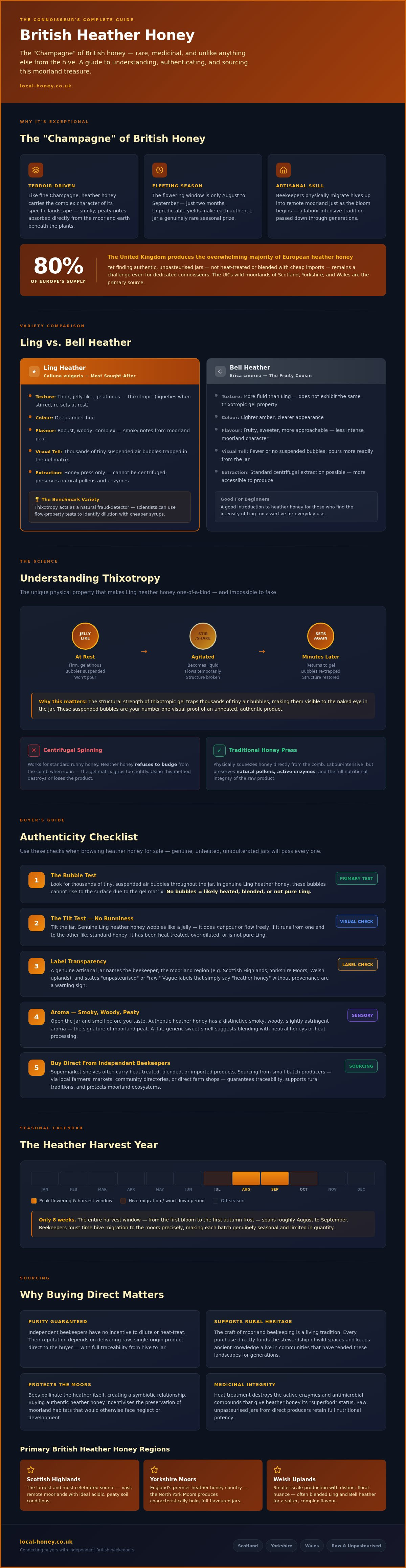
If you tip a jar of wildflower honey, it flows with a predictable, golden grace. Try the same with a jar of genuine Ling heather honey, and you'll witness something quite different. It doesn't pour; it wobbles. This fascinating characteristic is known as thixotropy. In its resting state, the honey is a thick, gelatinous substance. Once you stir or shake it, it temporarily becomes a liquid, only to return to its firm, jelly-like state minutes later. This physical magic is why you'll often see thousands of tiny, suspended air bubbles trapped within the jar, unable to rise to the surface because of the honey's structural strength.
This unique rheology is more than just a kitchen curiosity. It serves as a natural fingerprint of quality. Because of these complex flow properties, scientists can actually use specialised tests to detect the dilution of heather honey if it has been blended with cheaper, runny syrups. When you browse authentic heather honey for sale, these trapped bubbles and the lack of "runniness" are your best indicators that you're holding a pure, unadulterated product from the moors.
Why Traditional Extraction Methods Matter
The very property that makes this nectar so special also makes it a nightmare to harvest. Standard honey is extracted using centrifugal force, where frames are spun at high speeds to throw the liquid out of the wax cells. Heather honey, however, refuses to budge. To harvest it, beekeepers must use a "honey press," a traditional piece of equipment that physically squeezes the honey directly from the comb. Whilst this process is incredibly labour-intensive, it ensures that the resulting jar is rich in natural pollens and active enzymes that might otherwise be lost. If you're eager to experience this artisanal craft, you can find independent beekeepers who still use these heritage methods to preserve the honey's integrity.
The Sensory Profile: Colour, Aroma, and Flavour
The visual appeal of heather honey is striking, ranging from a deep, glowing amber to a rich reddish-orange that looks like a moorland sunset. Its aroma is equally evocative, carrying the scent of woodsmoke, old leather, and intense floral notes. On the palate, it offers a sophisticated balance. The initial sweetness is quickly followed by a slightly bitter, tangy finish that lingers long after the first spoonful. It is a bold, assertive honey that demands to be savoured slowly, reflecting the rugged landscape where it was forged. When looking for heather honey for sale, remember that these sensory markers are the hallmark of a truly wild harvest.
Ling vs. Bell Heather: Choosing the Right Character for Your Palate
When you begin searching for heather honey for sale, you'll quickly encounter two distinct varieties that define the British moorland: Ling and Bell. Whilst they often share the same purple-hued landscape, the honey they produce offers vastly different experiences for the palate. Ling heather, or Calluna vulgaris, is widely regarded as the "true" heather honey of the United Kingdom. It is the variety that exhibits the remarkable thixotropic gel-like texture discussed earlier. Bell heather, from the Erica genus, typically blooms a few weeks earlier and provides a more conventional, though equally exquisite, liquid consistency. Because bees are wild foragers, many jars available are actually a natural blend of both, capturing the full transition of the moorland summer.
Distinguishing between these two is vital for the connoisseur. Recent scientific advancements in the botanical authentication of heather honey have allowed producers to confirm exactly which nectar dominates their harvest. This precision is particularly important for products like Welsh Heather Honey, which has recently seen proposed amendments to its Protected Geographical Indication (PGI) status in 2026 to ensure its heritage is properly recognised. Whether you prefer the raw power of Ling or the bright fruitiness of Bell, knowing the origin of your jar ensures you're getting the specific character you desire.
Ling Heather: The Bold, Gelatinous Heavyweight
Ling is the undisputed heavyweight of British honeys. It possesses a pungent, almost primal aroma that fills the room the moment the lid is unscrewed. The flavour is intense and woody, often compared to the medicinal potency of Manuka honey due to its high levels of manganese and antimicrobial properties. Its unique texture makes it a favourite for those who enjoy a tactile eating experience. For the best pairing, try it alongside strong, salty cheeses like a mature Stilton or spread thickly over toasted sourdough. It also holds its own against game meats, where its smoky, resinous notes can truly shine.
Bell Heather: The Fruity and Aromatic All-Rounder
If Ling is a bold peat-smoke whisky, Bell heather is a rich, fruity port. It is characterised by a stunning dark amber colour, often with a reddish-orange hue that glows in the light. Unlike the gel-like Ling, Bell heather honey is smoother and runnier, making it an ideal choice for drizzling. Its flavour profile is brighter and more aromatic, with a cleaner finish that lacks the lingering bitterness of its counterpart. It is the perfect companion for a morning bowl of porridge or a dollop of Greek yoghurt. For a refined afternoon treat, try it with delicate pastries or scones to let its floral nuances take centre stage.
Authenticity Checklist: How to Spot Genuine Heather Honey for Sale
Identifying genuine heather honey for sale requires a keen eye and a healthy dose of skepticism. High street shelves are often cluttered with "heather-flavoured" blends that are little more than standard wildflower honey with a hint of moorland essence. Real heather honey is a heritage product, not a flavoured syrup. Its premium price reflects the sheer difficulty of the harvest, from the logistical feat of transporting hives to remote, acidic uplands to the manual labour of pressing the comb. If the price seems too good to be true, it likely is. You're paying for the artisan's time, the beekeeper's expertise, and the absolute rarity of the late-summer bloom.
Reading the Label: What "Raw" Actually Means
A "raw" label is your first line of defence. This term guarantees the honey hasn't been heated beyond the natural temperature of the hive. Heat is the ultimate enemy of quality here. Pasteurisation destroys the delicate enzymes and, crucially, breaks down the thixotropic structure that gives the honey its jelly-like soul. If a jar of heather honey is perfectly clear and runny, it has likely been heat-treated or over-filtered. Always look for a specific hive location or the beekeeper's name on the jar. Traceability is the hallmark of an honest, artisanal harvest. To ensure you're getting the real thing, you can browse our directory of independent beekeepers who specialise in these raw, unpasteurised varieties.
The Sensory Verification at Home
Once you have the jar in your kitchen, perform the "Bubble Test." Hold it up to the light; you should see thousands of tiny, spherical air bubbles trapped within the deep amber gel. These bubbles are suspended because the honey is too thick to let them rise. You can also try the "stir and set" test. Thixotropy describes the unique way this nectar acts as a solid gel until it is agitated; a characteristic beekeepers first witness during the traditional first pressing of the moorland harvest on 25 August. Once stirred with a spoon, it should liquefy, only to firm up again after resting for a few minutes. Finally, trust your nose. Genuine heather honey smells of woodsmoke, old leather, and slightly burnt sugar. It is a pungent, evocative scent that captures the wild, untamed spirit of the British moors.
Sourcing Small-Batch Excellence: Why Buying Direct Matters
Choosing to buy direct is a quiet act of rebellion against the anonymous, mass-produced jars found on supermarket shelves. When you look for heather honey for sale through independent channels, you're ensuring that the person who tended the bees and braved the moorland wind is the one who truly benefits. This direct connection creates a transparent chain of custody that no industrial blend can match. You know exactly where your honey was foraged, how it was handled, and why it tastes so remarkably distinct. It's about more than just a transaction; it's about supporting a fair price for a craft that requires immense physical toll and expertise.
There are significant environmental benefits to this local focus too. Independent British beekeepers are the unsung guardians of our wild spaces. By maintaining apiaries in remote upland areas, they ensure the continued pollination of the heather, which is vital for the health of the entire moorland ecosystem. Your purchase becomes a direct investment in British biodiversity. It supports the small-scale producers who prioritise the well-being of their colonies over the high-yield demands of global supply chains.
The Journey from Moor to Jar
The path from the purple-clad hills to your breakfast table is slow and methodical. It's a journey that follows the natural rhythm of the seasons, beginning with the heavy lifting of hives into the wilderness in August and ending with the patient, manual pressing of the combs. Beekeepers in this field act as a "steward of tradition," preserving heritage techniques that have remained largely unchanged for centuries. This isn't a factory process; it's a labour of love that respects the raw integrity of the nectar. Every jar you open is a testament to this dedication, representing an active act of conservation for the British countryside.
Finding Your Favourite Producer
Every moor has its own signature, a unique "terroir" shaped by the specific soil, weather, and blend of flora. A jar from the windswept Scottish Highlands may offer a different intensity to one from the rolling hills of Wales or the rugged Peak District. Our directory serves as a bridge to these hidden moorland apiaries, allowing you to discover specialists who understand the subtle nuances of their local landscape. We encourage you to explore different regions and experience the diverse character of the British harvest for yourself. Browse our register of British beekeepers to find heather honey for sale today and bring the authentic, seasonal spirit of the moors into your home.
Savour the Wild Essence of the British Moors
Finding genuine heather honey is a journey into the heart of our most rugged landscapes. It's a reward for those who value the slow, methodical work of nature and the dedicated beekeepers who steward it. You've discovered how to spot a true moorland harvest by its trapped bubbles and jelly-like soul; you also know why choosing raw, unpasteurised jars is essential for preserving that complex, smoky character. Every jar of heather honey for sale represents a profound commitment to the preservation of the British countryside and the survival of ancient artisanal skills.
By sourcing your nectar through our community, you enjoy direct-from-hive traceability whilst providing vital support for independent UK beekeeping. These small-batch treasures, sourced from wild British moorlands, offer a sensory experience that no mass-produced alternative could ever replicate. It's time to bring a piece of the purple-clad hills into your home and taste the history of the land.
Discover authentic heather honey from independent British beekeepers and begin your own connection with this rare, golden heritage.
Frequently Asked Questions
Is heather honey better for you than regular honey?
Heather honey is widely regarded as a superior health choice due to its high mineral content, particularly manganese, and its potent antimicrobial properties. Scientific research has highlighted that its antioxidant levels often surpass those found in standard blossom or wildflower varieties. This makes it an excellent natural support for the immune system. Many enthusiasts consider it the British equivalent of Manuka honey because of these concentrated bioactive compounds.
Why is heather honey so thick and jelly-like?
This unique consistency is caused by a physical property called thixotropy, which occurs due to specific proteins found in the nectar of Ling heather. In its resting state, the honey forms a stable, jelly-like gel that traps tiny air bubbles. Once you stir it with a spoon, it temporarily becomes liquid before resetting into a firm gel again. This fascinating tactile quality is a primary sign of a pure, high-quality harvest.
Can I buy heather honey all year round in the UK?
Whilst the harvest only takes place during the fleeting bloom of August and September, you can often find heather honey for sale throughout the year. Independent beekeepers typically jar their small-batch yields in the autumn and sell them until the following summer. However, because yields are unpredictable and dependent on moorland weather, stocks can run low by spring. It's always best to buy shortly after the autumn pressing.
What is the difference between Scottish heather honey and English heather honey?
The primary difference lies in the "terroir" of the specific moorland. Scottish heather honey is world-renowned for its purity, often sourced from the vast, remote Highlands where Ling heather dominates. English varieties, such as those from the Yorkshire Moors or the Peak District, may have a slightly different aromatic profile influenced by the surrounding flora. Both offer exceptional quality, but the Scottish harvest is often more intensely woody and pungent.
Does heather honey ever crystallise or go hard?
Heather honey does crystallise, but it happens much more slowly and with a coarser texture than regular blossom honey. Instead of turning into a solid, smooth block, it develops large, sugary crystals within its gelatinous structure. Because it is thixotropic, it retains its characteristic wobble even as these crystals form. If your honey does set firmly, a very gentle warming in a bowl of tepid water will soften it.
Why is heather honey more expensive than wildflower honey?
The premium price reflects the significant logistical challenges and labour-intensive methods required for its production. Beekeepers must physically transport their hives to remote, often inaccessible moorlands specifically for this short flowering window. The honey's thick texture means it cannot be spun in a standard centrifuge. It must be painstakingly squeezed out using a traditional honey press, which is a much slower and more manual process.
How should I store my raw heather honey to keep it fresh?
To preserve the delicate enzymes and complex flavour profile, you should store your jar in a cool, dark place like a kitchen cupboard. Ensure the lid is tightly sealed to prevent the honey from absorbing moisture from the air. Never store your honey in the fridge, as the cold temperatures will speed up the crystallisation process and make the texture less palatable. Room temperature is ideal for maintaining its unique gel-like soul.
Is all heather honey raw and unpasteurised?
Not all heather honey for sale is raw. Some large-scale commercial producers heat-treat their honey to make it easier to filter and bottle. This pasteurisation process destroys the natural enzymes and ruins the honey's unique thixotropic texture. To experience the true benefits and flavour of the moors, always look for jars explicitly labelled as "raw" or "unpasteurised" from independent beekeepers who respect the traditional harvest.


